Did the Sun Really Stand Still? Bible Stories Debunked

Throughout history, sacred texts have captivated billions of minds, offering moral guidance, historical context, and spiritual comfort. However, when we read ancient texts through a modern scientific lens, certain passages push the boundaries of credulity. Among the most famous is the tale of Joshua commanding the sun to stand still in the sky.
Did the sun actually halt its celestial journey? Or are we reading ancient poetic hyperbole? In this deep dive, we explore some of the most scientifically absurd stories in the Bible, examining what modern science, historical context, and biblical scholarship have to say about them.
1. Joshua’s Long Day: Did the Sun Stand Still?
According to the Book of Joshua (10:12-14), during a battle at Gibeon, Joshua needed more daylight to defeat the Amorites. He reportedly cried out, “Sun, stand still over Gibeon, and you, moon, over the Valley of Ajalon.” Miraculously, the text claims the sun stood still for about a full day.
The Scientific Reality
From an astronomical standpoint, the sun does not orbit the Earth—the Earth orbits the sun and rotates on its axis. For the sun to “stand still,” the Earth would have to abruptly stop its rotational velocity of roughly 1,000 miles per hour at the equator.
Physics tells us that if the Earth stopped spinning instantaneously, everything not strapped down—including oceans, atmosphere, buildings, and people—would continue moving eastward at 1,000 miles per hour, creating global cataclysmic winds, tsunamis, and destruction. Needless to say, no geological layer shows evidence of a sudden planetary stop.
The Theological/Historical Explanation
Biblical scholars point out that ancient Near Eastern war poetry frequently used exaggerated, hyperbolic language to describe glorious victories. Describing a battle moving so fast and successfully that it felt like daylight was extended is a common literary trope, rather than a recorded physics-defying event.
2. Jonah and the Whale: Surviving Inside a Sea Monster
The story of Jonah is a Sunday school classic: a rebellious prophet is thrown overboard, swallowed by a “great fish” (often traditionally translated as a whale), spends three days and nights in its belly, and is safely vomited onto dry land.
The Scientific Reality
Biologically and physiologically, human survival inside the digestive tract of a marine mammal is impossible. Whales—even sperm whales, which can swallow large objects—have throats too narrow to swallow a human whole without crushing them. Furthermore, the stomach lacks oxygen, contains crushing digestive acids, and is filled with immense pressure.
The Theological/Historical Explanation
Most modern theologians—even conservative ones—view the Book of Jonah not as a strict journalistic account, but as a satirical novella or a piece of parabolic literature. Much like Jesus’s parables, the story uses absurdity to make a theological point about divine mercy and human stubbornness.
3. The Global Flood of Noah’s Ark
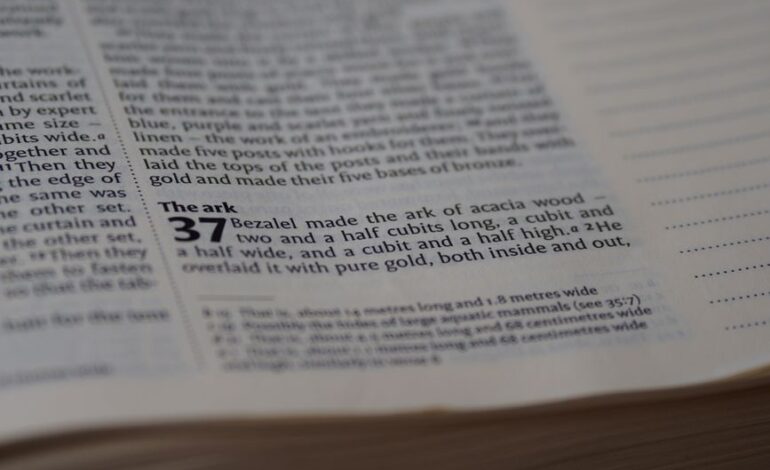
The narrative of Noah’s Ark describes a worldwide deluge that covered the highest mountains, wiping out all air-breathing land animals except those safely housed inside a wooden ark alongside Noah’s family.

The Scientific Reality
Geologists, paleontologists, and biologists have universally rejected a literal global flood due to a mountain of contradictory evidence:
- Water Volume: There is simply not enough water on Earth (even if all polar ice caps melted) to cover Mount Everest.
- Biodiversity: Biogeography shows that species evolved in specific regions (like kangaroos in Australia). A centralized ark landing in the Middle East would require koalas and penguins to migrate thousands of miles across oceans and hostile climates.
- The Fossil Record: The geological strata show millions of years of gradual deposition, not a single catastrophic muddy year that neatly sorted fossils by evolutionary complexity.
The Theological/Historical Explanation
Scholars note that the Genesis flood story shares strong structural and narrative similarities with older Mesopotamian flood myths, such as the Epic of Gilgamesh and the Epic of Atrahasis. To the ancient writer, their “world” was the local river valley. A devastating local or regional flood could easily be mythologized over generations into a cosmic, world-ending event.
4. Talking Animals: The Serpent and Balaam’s Donkey
Throughout the Bible, animals occasionally converse with humans. The serpent in the Garden of Eden tempts Eve with complex philosophical reasoning, and in Numbers 22, the prophet Balaam’s donkey speaks up to rebuke its abusive master.
The Scientific Reality
Animals do not possess the vocal tracts, cognitive capacity, or linguistic structures necessary to formulate human speech. While parrots and corvids can mimic sounds, they do not understand syntax, semantics, or abstract concepts.
The Theological/Historical Explanation
Fables and allegories often feature talking animals (think of Aesop’s Fables). In ancient literature, the use of a talking animal was a standard narrative device used to deliver moral or spiritual truths—often highlighting how foolish humans are when even a beast can recognize divine reality.
Why Do We Misinterpret Ancient Texts?
The core issue behind labeling these Bible stories as “absurd” lies in chronological snobbery—the unexamined assumption that our modern, scientific way of writing history is the only valid way to record the past.
Ancient people did not have peer-reviewed scientific journals, physics equations, or carbon dating. They expressed truths through mythology, folklore, poetry, and hyperbole. When modern readers demand that ancient texts conform to 21st-century journalistic standards, we miss the profound psychological and spiritual truths these stories were actually trying to convey.
Conclusion: Myth vs. Literalism
Did the sun really stand still? Scientifically, absolutely not. Did a whale swallow a man who lived to tell the tale? Biologically, no.
However, recognizing these stories as ancient literature rather than modern science does not diminish their cultural and historical value. By understanding them through their proper literary context, we can appreciate the Bible for what it truly is: a rich tapestry of human reflection, philosophy, and faith.