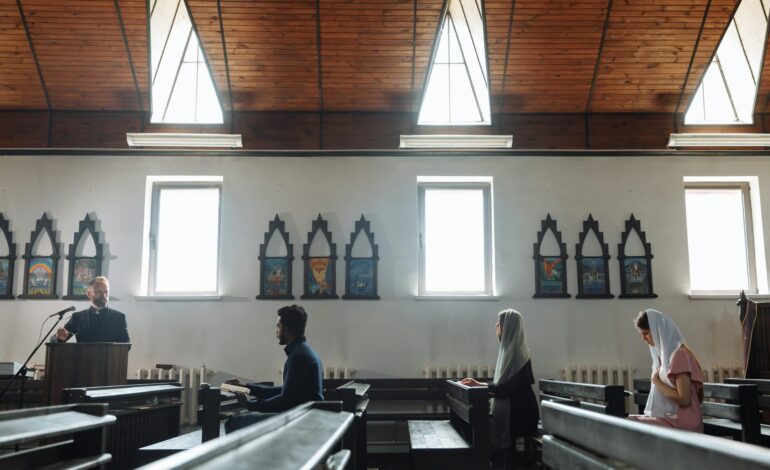
The Evolution of Ideas: How Secularism Adapts to Changing Times

{
“html_content”: “
Introduction
\n
The concept of secularism has undergone a remarkable transformation throughout history, evolving from a simple separation of church and state to a complex philosophical framework that shapes modern societies. As our world becomes increasingly interconnected and diverse, secularism continues to adapt, addressing new challenges and reflecting changing societal values. This article explores the fascinating journey of secular thought, examining how it has responded to historical events, technological advancements, and shifting cultural landscapes.

\n\n
The Historical Roots of Secularism
\n
Secularism’s origins can be traced back to ancient civilizations, where early forms of separation between religious and political authority began to emerge. In ancient Greece, philosophers like Epicurus advocated for a rational approach to understanding the world, challenging traditional religious explanations. Similarly, in ancient India, the Charvaka school of thought promoted materialism and skepticism towards religious doctrines.
\n\n
The modern concept of secularism, however, took shape during the Enlightenment period in Europe. Thinkers like John Locke and Voltaire championed the idea of religious tolerance and the separation of church and state. This intellectual movement laid the groundwork for the development of secular governments and the protection of individual freedoms.
\n\n
Secularism in the Age of Revolution
\n
The American and French Revolutions marked significant milestones in the evolution of secularism. The United States Constitution, with its First Amendment guaranteeing freedom of religion and prohibiting the establishment of a state religion, became a model for secular governance. The French Revolution took a more radical approach, attempting to completely remove religious influence from public life through measures like the Civil Constitution of the Clergy.
\n\n
These revolutionary ideals spread across the globe, influencing the formation of secular states in Latin America, Asia, and Africa. However, the implementation of secularism varied widely, often reflecting local cultural and historical contexts. For example, the secular model in Turkey under Mustafa Kemal Atatürk involved a complete overhaul of the existing social and political structures, while India’s approach to secularism emphasized religious pluralism and equal treatment of all faiths.
\n\n
The Challenges of Modern Secularism
\n
As societies have become more diverse and interconnected, secularism faces new challenges that require innovative solutions. The rise of religious fundamentalism and the increasing visibility of minority religious groups have put pressure on secular states to balance the protection of individual rights with the preservation of social cohesion.
\n\n
One of the most contentious issues in modern secularism is the debate over the role of religion in public spaces. The controversy surrounding the wearing of religious symbols in schools and government buildings, such as the French ban on conspicuous religious attire, highlights the tension between individual expression and the principle of state neutrality. Similarly, the accommodation of religious practices in the workplace, such as prayer rooms or flexible holiday schedules, has become a complex issue for secular institutions to navigate.
\n\n
Secularism in the Digital Age
\n
The advent of the internet and social media has dramatically altered the landscape of secular discourse. Online platforms have become battlegrounds for debates on religious freedom, scientific rationalism, and the role of faith in public life. The democratization of information has empowered secular voices and facilitated the spread of atheistic and agnostic perspectives, challenging traditional religious authority.
\n\n
However, the digital age has also given rise to new forms of religious expression and community-building. Virtual religious spaces, online religious education, and digital evangelism have transformed how people engage with faith. This digital religious revival presents a unique challenge for secular societies, as they must adapt to a world where the boundaries between the sacred and the secular are increasingly blurred.
\n\n
The Future of Secularism: Adapting to a Changing World
\n
As we look to the future, it is clear that secularism will continue to evolve in response to emerging global challenges. The rise of artificial intelligence and biotechnology raises profound questions about the nature of human existence and the role of religion in shaping our understanding of consciousness and morality. Secular thinkers will need to engage with these complex issues, developing new frameworks for ethical decision-making that can accommodate both scientific progress and diverse cultural perspectives.
\n\n
Climate change and environmental degradation present another area where secularism must adapt. As traditional religious narratives about humanity’s relationship with nature are challenged, secular philosophies will need to develop compelling alternatives that can motivate collective action and inspire a sense of global responsibility. The concept of “eco-secularism,” which combines environmental stewardship with secular ethics, may emerge as a powerful force in shaping future policy and public discourse.
\n\n
The increasing secularization of global politics also presents both opportunities and challenges for the future of secular thought. As religious influence wanes in many parts of the world, secular values such as human rights, democracy, and scientific rationalism have gained prominence. However, this shift also raises questions about how to maintain social cohesion and moral guidance in the absence of traditional religious frameworks. The development of secular humanism and other non-religious ethical systems may play a crucial role in addressing these concerns.
\n\n
Conclusion
\n
The evolution of secularism is a testament to the adaptability and resilience of human thought. From its ancient roots to its modern manifestations, secularism has consistently responded to the changing needs and challenges of society. As we face an increasingly complex and interconnected world, the ability of secular thought to evolve and address new issues will be crucial in shaping the future of our global community.
\n\n
The journey of secularism is far from over. As we navigate the challenges of the 21st century, from technological disruption to environmental crisis, the principles of secular thought will continue to adapt and provide a framework for rational discourse, individual freedom, and social progress. By understanding the historical evolution of secularism and its current challenges, we can better appreciate its role in shaping our collective future and work towards a more inclusive, rational, and just society.
“,
“meta_title”: “The Evolution of Secularism: Adapting to Modern Challenges”,
“meta_description”: “Explore how secularism has evolved from ancient times to the digital age, adapting to new challenges and shaping modern societies. Discover the future of secular thought.”,
“image_alt_text”: “Abstract representation of the evolution of secularism through different historical periods and modern challenges”
}